
Five Essential Literacies for Translators in the Age of AI
Go beyond the tools and work with AI with authority.
Learn to understand the engines, direct them clearly, judge what they produce, protect your clients' data, and advise clients on what AI can and cannot do for their readers.

Why This Course Matters
AI has transformed translation workflows, yet most professional conversations focus on software that will be out of date next year. What lasts are the competencies behind the tools.
A fluent AI draft now costs almost nothing. That moves your value to the decisions around the draft: what to ask the system, how to judge its output, whether the text can safely go through it, and what to tell the client. This course gives you a framework for those decisions, so you can work as a linguistic architect of AI-assisted workflows, not as an operator of someone else's tool.
The Five Literacies
Each literacy answers one question you face on the job:
- Model Literacy — What can this system do, and where will it fail? Understand how LLMs and neural MT work: context windows, embeddings, tokenization, and temperature.
- Interaction Literacy — How do I get the output I need? Direct systems with prompting techniques and with plain language as an upstream strategy: clear input reduces ambiguity and prompt failure, from single prompts to APIs and RAG pipelines.
- Evaluation Literacy — Is this good enough, and how much editing does it need? Pinpoint hallucinations, register drift, and terminology drops with MQM/DQF, and pair them with COMET and BLEU to triage post-editing effort.
- Data Literacy — Can this text safely go through this tool? Navigate data provenance, training bias, confidentiality, zero-data-retention tools, and GDPR, CCPA, and organizational AI policies.
- Risk & Advisory Literacy — Will this work for the reader and for the client? Reduce cognitive overload and reader exclusion with accessible, plain language, and advise clients on human-in-the-loop ethics, AI pipelines, and services beyond per-word pricing.
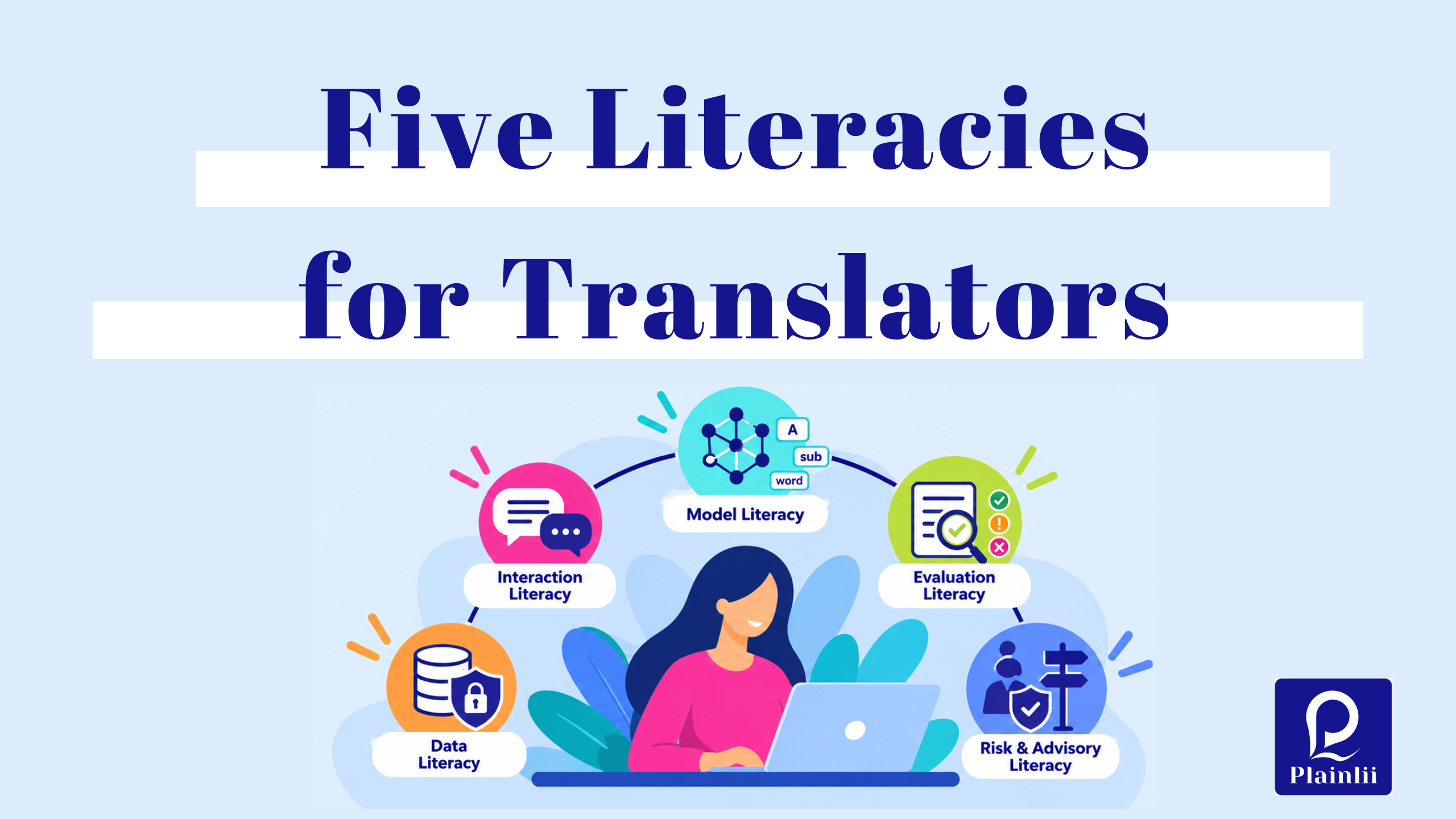
This is the course image on learn.plainlii.com. Look for it on your dashboard after you enroll.
What You’ll Learn
Through short readings, hands-on practice, and discussion with other translators, you will learn how to:
- anticipate where an AI system will struggle before you use it
- write prompts that work, using examples, constraints, and plain language
- classify errors in AI output and decide when to automate, lightly post-edit, or rewrite
- check that your tools and workflow respect client confidentiality and the law
- make sure the final text works for every reader, following ISO 24495-1
- explain AI to clients and offer services that go beyond per-word rates
You’ll finish with a personal 90-day action plan, with one step for each literacy.
Who This Course Is For
Professional translators and interpreters who already use CAT tools and want to work confidently alongside AI. No programming or technical background is needed.
The course is self-paced. Plan on about one hour a week for six weeks.
Course Syllabus
Course Syllabus Overview
The course has a welcome section, six modules, and a wrap-up. Module 1 explains how the translator's role is changing. Modules 2 to 6 each build one literacy.
Each module includes a short reading, a practice exercise, a discussion, and a knowledge check. You complete the course when you pass every knowledge check and post in each discussion.
Start Here: Welcome and Orientation
See how the course works and meet the group.
- The five literacies and how the course is paced
- How to get help
- Introduce yourself: your language pairs, specialty, and how you use AI today
Module 1: The Paradigm Shift — From Operators to Linguistic Architects
Why the translator's role changes when the machine writes the first draft.
- Why fluency is cheap, and accuracy, fitness for purpose, and accountability are not
- The decisions that now carry the value, and the literacy behind each one
- Practice: Map where AI enters your own workflow
Module 2: Model Literacy
Know what the system can do, and where it will fail.
- How neural MT and large language models produce text
- Context windows, embeddings, tokenization, and temperature
- Predicting common failures: long documents, rare terms, low-resource languages
- Practice: Predict and then test where a system struggles with one of your texts
Module 3: Interaction Literacy
Get the output you need.
- Prompting techniques: few-shot examples, persona constraints, reverse prompting
- Plain language as an upstream strategy: ISO 24495-1 clarity and functional sentence perspective in your prompts
- From single prompts to APIs, RAG, and automated terminology
- Practice: Steer one source text with four different prompts and compare the results
Module 4: Evaluation Literacy
Judge AI output, and decide how much editing it needs.
- MQM and DQF error typologies for AI errors: hallucinations, register drift, terminology drops
- What COMET, BLEU, and quality estimation can and can't tell you
- Triage: automate, light post-edit, or rewrite
- Practice: Error classification workshop
Module 5: Data Literacy
Translation is data stewardship.
- Data provenance and bias in training data
- Confidentiality: zero-data-retention tools vs. consumer AI
- NDAs, GDPR, CCPA, and organizational AI policies
- Practice: Audit your AI tools against your clients' NDA terms
Module 6: Risk & Advisory Literacy
Make sure the text works for readers, and help clients make good decisions.
- Cognitive overload and reader exclusion: the downstream risks of AI text
- Plain language (ISO 24495-1) and accessibility for every reader
- Advising clients: human-in-the-loop ethics, AI pipeline design, services beyond per-word pricing
- Practice: Write a one-page, plain language explainer for a client tempted by raw MT
Wrap-up: Your Personal Action Plan
- One action for each literacy for the next 90 days
- Share one commitment with the group
Contact us
Reach out, we try to answer all emails within 24 hours on business days.
We will be happy to answer your questions and help you achieve bolder communication results with writing, translation, and elearning!